
Artificial intelligence in ocean work is not always a robot swimming beside a diver. A preprint submitted on September 30, 2026 describes a system that photographs and counts tiny young corals during aquaculture. Its practical target is the repetitive monitoring needed while corals are being raised for research and restoration.
What the research system does
The CGRAS preprint combines robotic image collection with computer vision to detect and count coral recruits on standardized settlement tiles. The authors report a comparison with manual monitoring, including a 9.6-fold reduction in time and labor costs and 96.4 percent agreement with expert counts for Acropora kenti.
Those figures belong to the evaluation described by the authors. They should not be converted into a claim that the system restores reefs 9.6 times faster or identifies every coral in open water with the same agreement. The publication is a preprint, and TRIMIX has not independently reproduced its tests.
A development history before the September paper
An AIMS account published January 15, 2026 describes CGRAS as a robotic camera system used to repeatedly image coral tiles at the National Sea Simulator. It identifies collaboration between QUT and AIMS and explains the aim of reducing the workload involved in monitoring young corals. This is older institutional background, so the recent preprint should not be described as the first appearance of the technology.
Keeping those dates together gives a clearer development story: a facility system already described by its collaborators, followed by a paper presenting methods and reported evaluation. Neither date alone establishes that a consumer product is available.
Count accuracy and restoration success are separate questions
A useful monitoring tool can help operators understand what is happening on a tile. It does not by itself answer what happens after corals are deployed, how an ecosystem changes over time, or which restoration approach is appropriate at another location. Those outcomes require their own evidence.
When reading a demonstration, ask what object was counted, what an expert used as a reference, and which conditions were included. An agreement figure is easier to interpret when the organism, setting, and comparison remain attached to it. A single large percentage without those details is less informative.
Why this matters to divers following AI
The interesting application here is a defined production and research task. It shows why useful underwater technology can be highly specialized, with lighting, repeatable imaging, and an organized workflow. It does not establish that similar-looking cameras or consumer AI software provide an equivalent capability.
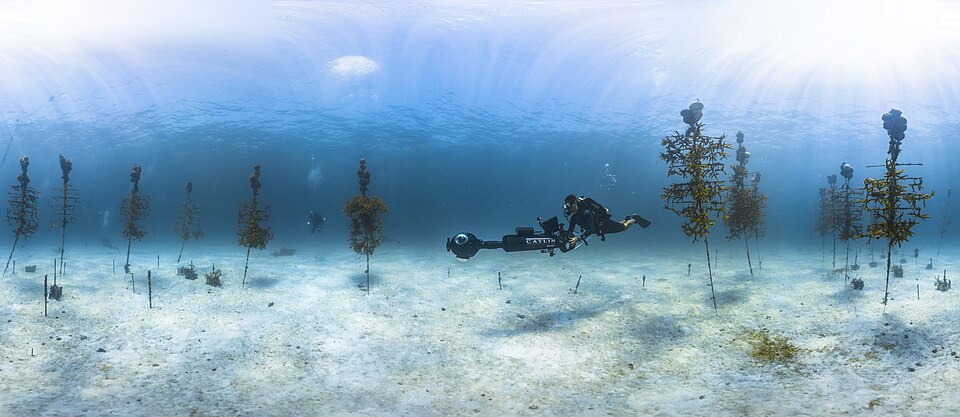
For a dive club discussion, compare the monitoring question with the wider restoration question and identify the evidence needed for each. For an actual equipment inquiry, use TRIMIX Support and specify the exact model. Sources checked October 24, 2026; the photograph is contextual and does not depict CGRAS or a performance test.
Join the discussion
Share a question or a useful experience about this article. Every comment is reviewed before it appears.