
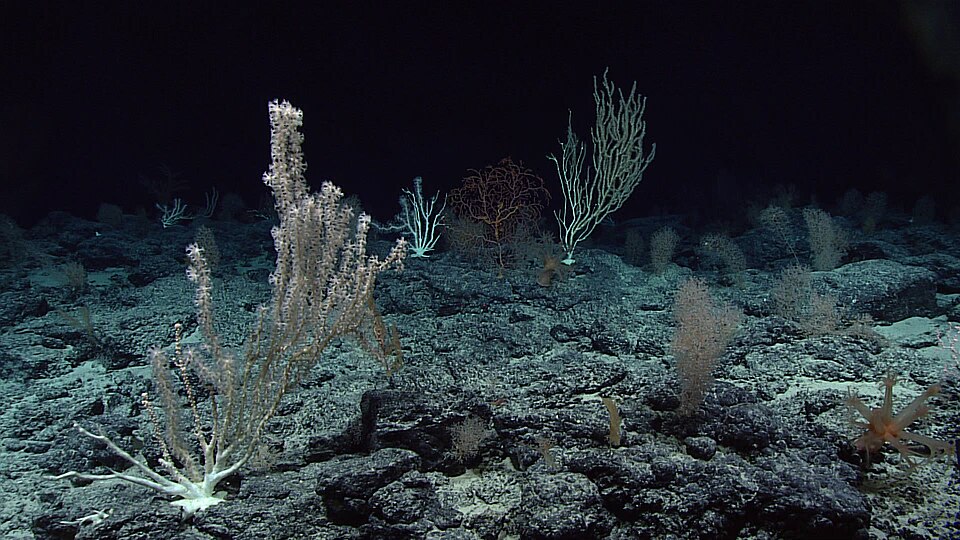
The newly reported coral atoll in the equatorial Atlantic is an ancient structure with living deep-sea communities on it. Those two descriptions concern different things. In its November 23 report, Schmidt Ocean Institute describes a fossil coral platform and the present-day gardens above it. The discovery does not mean that the individual living corals are millions of years old.
Keep the geological structure and living habitat separate
The institute reports a submerged atoll approximately five million years old in the Romanche Fracture Zone, with its top about 900 metres below the surface. It describes fossil shallow-water coral material in the structure and living deep-water corals occupying it today. The report concerns an expedition that finished in October, rather than a new voyage beginning on the announcement date.
For a reader, the useful distinction is between evidence about what formed a structure and observations of what occupies it now. A photograph of living animals can document the present habitat. Interpreting the age and origin of the underlying formation requires the geological evidence described by the research team. One picture should not silently be made to answer both questions.
Why the expedition used more than a camera
Schmidt Ocean Institute’s expedition background page explains why this equatorial Mid-Atlantic setting attracted researchers: steep and varied terrain, currents and a substantial gap in biological observations. Sparse earlier samples had left uncertainty about the region’s ecosystems. The project was organised to investigate that gap, not to inventory a familiar recreational reef.
The November account describes ship and autonomous-vehicle mapping followed by remotely operated vehicle observations. These supply connected forms of evidence: a mapped setting helps locate a feature, while close observations reveal organisms and materials at particular places. Their value comes from the connection, including where each observation was made.
| Question | Record to look for in subsequent research |
|---|---|
| What is the formation? | Geological interpretation and the samples supporting it. |
| What lives there now? | Located observations, identification work and any unresolved names. |
| How representative is one view? | The surveyed area and coverage beyond the selected photograph. |
A discovery report opens further questions
The researchers expect substantial follow-up analysis. Treat future species descriptions, habitat comparisons and geological publications as their own outcomes. An institutional expedition report can explain an important finding without establishing that every sample has been identified or every interpretation independently reproduced.
For divers and reef enthusiasts, the report offers a view of a remote ecosystem rather than a destination or equipment recommendation. It gives no basis for recreational access, collecting specimens or extending a diving configuration’s intended use.
Checked November 28, 2026. The findings report was published and modified November 23. The expedition background page’s metadata gives November 4 publication and November 10 modification. The contextual photograph does not show the Romanche discovery site or this expedition.
Join the discussion
Share a question or a useful experience about this article. Every comment is reviewed before it appears.