
RLSS UK’s current “Technology in Swimming Pools” page identifies version 2, marked October 2026, with a footer update of October 21. It provides vocabulary for asking what a pool’s monitoring equipment actually does. Read the current RLSS UK guidance statement.
Different systems have different jobs
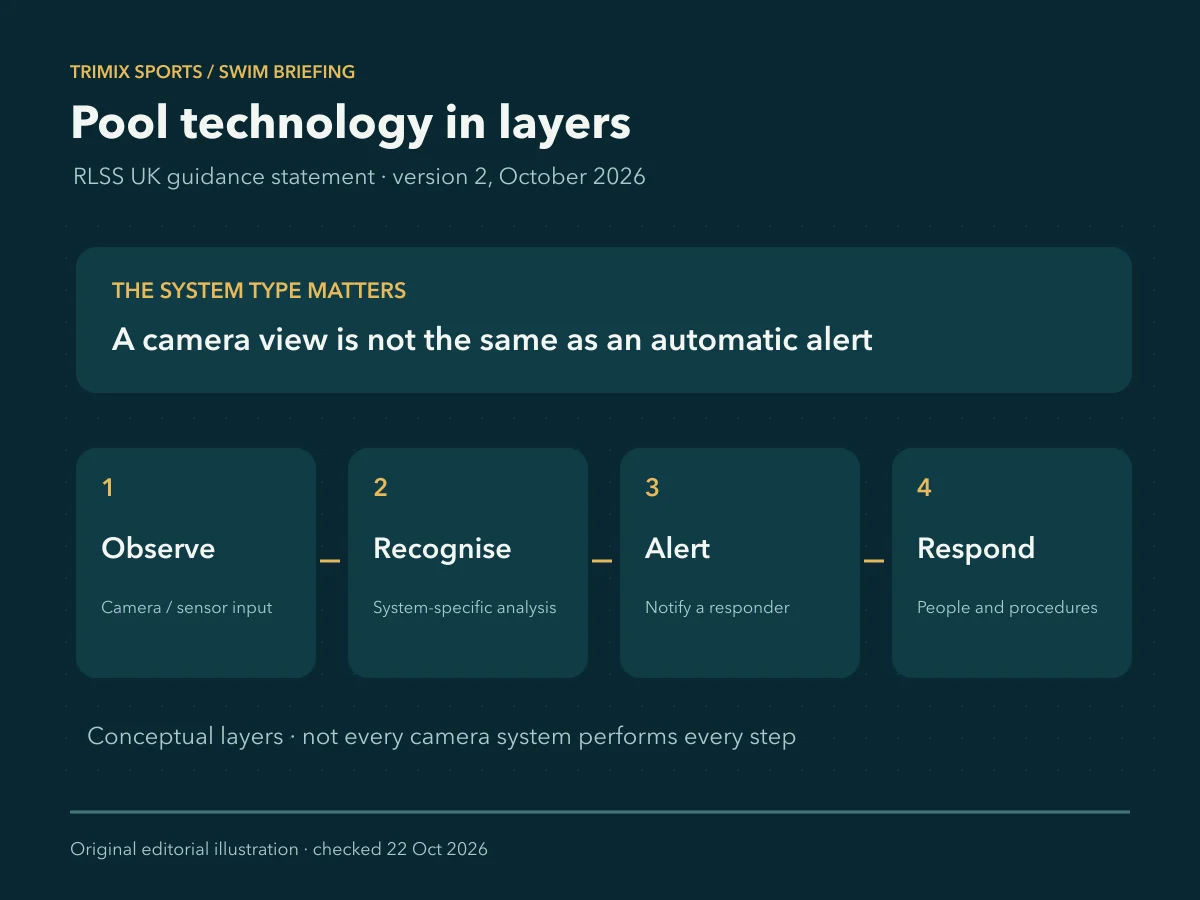
RLSS UK distinguishes AI-assisted swimmer-behaviour analysis, submersion-detection systems, personal wearable detection devices, and underwater or overhead cameras. The first categories may generate alerts for a lifeguard or responder. Ordinary camera-view systems, the guidance explains, do not automatically raise alarms. Wearable systems depend on swimmers wearing the device. Treating all these arrangements as one “smart pool” feature hides differences that matter.
Operators are advised to assess suitability, visibility and risks, update procedures, plan for failures and train staff. The statement does not establish that a particular gadget makes a facility safe or endorse a commercial brand.
Guidance and legislation are different documents
The UK’s Health and Safety Executive separately provides HSG179, Health and safety in swimming pools. Its publication page identifies a 2018 fourth edition, later reissued with minor amendments, and describes guidance for people operating and managing pools. It is intended to help reduce risks and comply with the law. That does not make RLSS UK’s October webpage update a newly enacted national statute, or turn it into a rule applying to every country.
Questions a swimmer can reasonably ask
Our editorial takeaway is to ask about the complete service rather than the badge on a camera. What supervision is provided during the session you plan to attend? What does the displayed technology actually do? Who receives an alert? Where can you find the operator’s current customer information?
For an operator assessing equipment, begin with the current guidance, the facility’s risk assessment and the exact manufacturer’s documentation. A public news summary is too limited to specify staffing, choose a detection threshold or design a response procedure. A demonstration clip also cannot establish how a system performs across the conditions of a different pool.
This article contains no equipment test and no guarantee about any detection system. Its purpose is to make the distinction between observing, recognising, alerting and responding easier to see.
Ask TRIMIX about the documented specifications of a named catalogue item. TRIMIX’s catalogue should not be assumed to include the pool-monitoring systems described here.
RLSS UK page originally published November 19, 2020; version 2 marked October 2026, page updated October 21, 2026. HSE publication: 2018, publication page notes a February 2024 update. Both checked October 22, 2026. Source-based technology explanation, not a facility risk assessment.
Join the discussion
Share a question or a useful experience about this article. Every comment is reviewed before it appears.