
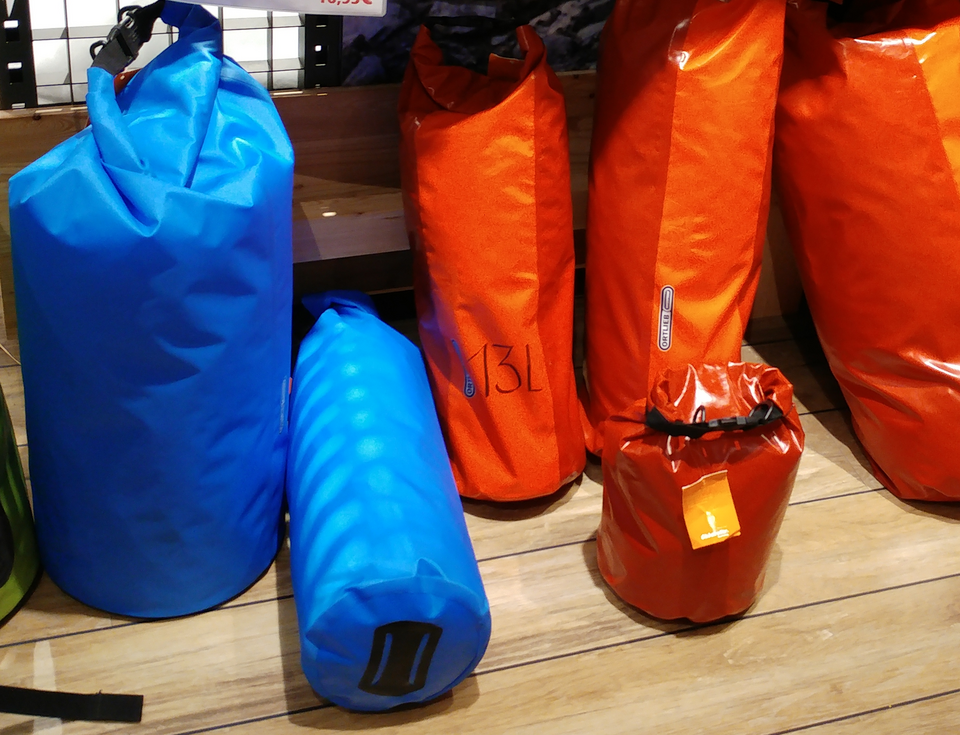
A roll-and-clip top describes a closure, not a complete water-protection rating. A snorkeling bag may use that closure while intentionally allowing water to escape through its body or base. Before choosing a bag, decide whether its job is to carry wet equipment or keep selected contents dry.
Compare the whole construction
SCUBAPRO’s Sport Mesh 65 page describes mesh combined with fabric, a roll-top opening, side-zipper access and a base eyelet for water evacuation. The closure therefore cannot, by itself, be read as a promise that the bag excludes water.
ORTLIEB’s Dry-Bag Light PS10 information gives a different, explicit scope: its stated IP64 protection requires the top to be rolled at least five or six times. The sheet describes splash protection and warns that water can enter through the closure if the bag is completely submerged. Those conditions belong to that product, not to every bag called dry.
Choose the direction in which water must move
For wet fins, a mask case and other rinsed equipment, ask how the bag releases water and which contents need their own protection. For items that must stay dry, identify the exact exclusion claim and closure instructions. A draining gear carrier and a protective inner container can perform separate tasks within the same transport plan.
Make a two-column list: wet equipment carried, and contents requiring protection. Then record the bag’s body construction, openings, closure, rating if supplied, and restrictions. Do not infer an immersion claim from a seaside product photograph or assume a separate pocket has the same protection as another compartment.
Account for closure space and access
Ask which dimensions apply with the top properly closed and whether all required rolls remain possible at the intended load. A bag that holds an item while open may not accommodate it under its specified closure conditions. Keep the manufacturer’s capacity description alongside the actual closure instructions.
Consider what happens when you use a side zip or open a pocket during transport. Ask which compartment a protection claim covers. Keep equipment care separate: transport in a wet-kit carrier is not proof that damp gear is ready for long-term storage. Follow the care directions for each item instead of leaving it enclosed indefinitely.
Ask for construction and claim together
Use the TRIMIX buying guide and ask about the proposed gear bag’s drainage, closure and documented protection. Name the contents and the transport situation. These examples establish neither TRIMIX bag stock nor an immersion rating for an unspecified product.
Evergreen equipment guide checked November 2, 2026. The linked source pages are undated unless a printed revision is stated above; current availability is not established by this guide. Manufacturer descriptions are documentation examples, not TRIMIX hands-on tests or guarantees of personal suitability.
Join the discussion
Share a question or a useful experience about this article. Every comment is reviewed before it appears.