
A camera seen in an ocean documentary may be an earlier field instrument or a design still being tested. Ocean Discovery League’s 10 November announcement for Expedition: Saving Our Seas gives viewers a good example. The film features two generations of imaging work, Maka Niu and the Deep Ocean Research and Imaging System, known as DORIS. Keeping those two names separate makes it much easier to follow what each device did.
Start with the instrument named for the footage
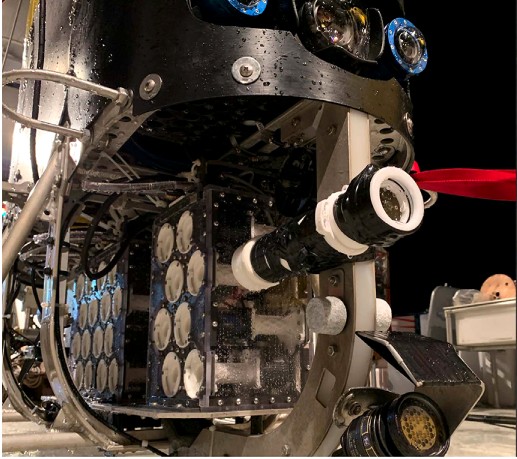
In its film announcement, Ocean Discovery League describes Maka Niu deployments in The Gambia and in Gjoa Haven, Nunavut, with earlier development at the MIT Media Lab. The authors’ 2022 research paper on Maka Niu describes an imaging and sensor module with its own housing and controls. Figure 9 documents an earlier experiment in which the team mounted it alongside the main camera of the Mesobot research vehicle. The archived photograph above shows that arrangement. It is a useful example of a camera recording observations while another platform handles the deployment.
The same paper describes a separate deployment on a baited camera system. For a reader who works with underwater images, the useful comparison is the platform that carries the camera, what the camera and sensors record, and how the deployment is documented. The paper’s field examples answer those questions for specific deployments rather than for every way the device could be used.
Read the successor’s project description alongside the film notice
Ocean Discovery League says that lessons from Maka Niu informed DORIS and that the team first test-deployed DORIS in Monterey, California. Its DORIS project description describes the first generation as a beta system and gives an engineered depth rating of 6,000 metres. It lists modules for imaging, lighting and environmental measurements. Development partner Blue Robotics describes commercialization as following refinement of the first generation. The rating, the reported Monterey test and any future product offering are three different pieces of evidence. The notice does not give a measured depth for that deployment.
Use three questions while watching
Which camera recorded the shot? What platform carried it and where was it deployed? Does the source give the measured result or the design target? The answers distinguish a documented field image from a test report or an engineering specification. Ocean Discovery League’s announcement lists a television premiere for 13 November and streaming from 14 November. Check the broadcaster’s schedule where you live.
Evidence dates. Ocean Discovery League’s film notice was published 10 November 2026. The original Maka Niu paper was published 17 November 2022. The two DORIS project descriptions are undated. All sources checked 11 November 2026.
Join the discussion
Share a question or a useful experience about this article. Every comment is reviewed before it appears.