
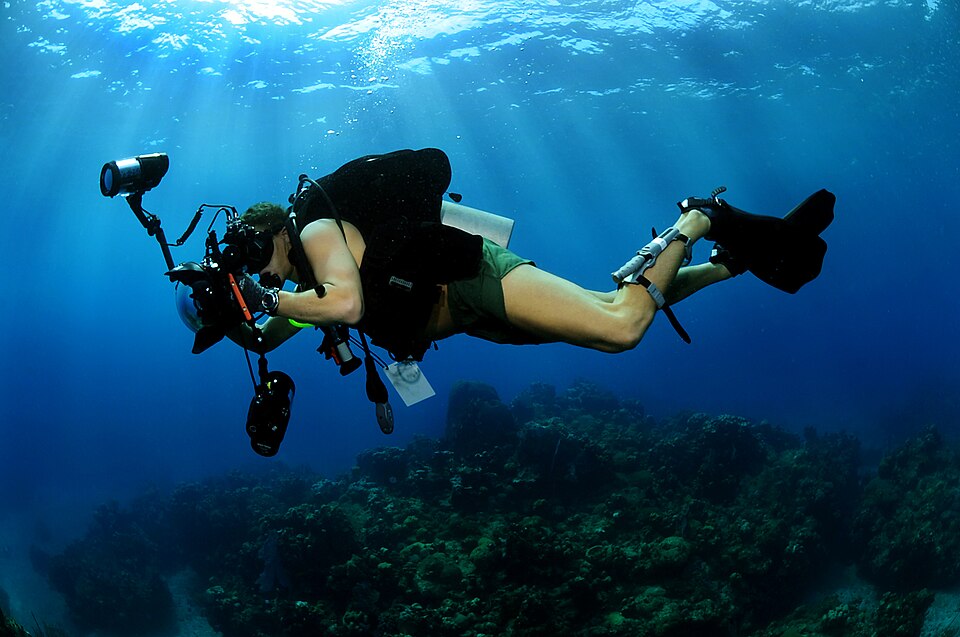
Ask whether the light’s published beam angle is measured in air or underwater before comparing it with your snorkeling camera’s view. A broad beam number on the box can describe a different condition from the one in which you will film. Keep beam coverage and brightness in separate columns.
Check the measurement beside the number
The SeaLife 2025 product guide says its Sea Dragon beam-angle figures are measured in air. It gives 120 degrees in air and approximately 90 degrees underwater as an example of the change caused by refraction. Retain that example with its maker and measurement condition; do not apply the same conversion to an unidentified light or optical design.
SeaLife’s current light-selection chart lists the Pro Dual Beam SL679 with a 120-degree wide beam and a 15-degree spot beam. The corresponding peak outputs are 3,000 and 1,500 lumens. Those are two modes on the named product. A spot mode with a smaller lumen figure is not simply a weaker version of the same wide illumination pattern.
Build a comparison for the shot you want
| Record | Question to resolve |
|---|---|
| Camera and selected view | Which lens, housing port and recording mode will you use? |
| Light beam | Is the angle specified in air or water, and for which mode? |
| Output | Which brightness level belongs to that beam? |
| Complete rig | What mount, tray, battery and charger are actually included? |
Send the camera’s exact viewing configuration to the light supplier. Request an explanation of the documented coverage and any relevant sample footage made with the same combination. Treat footage as an example with its own water conditions and subject distance. It does not promise evenly lit frames on your trip. If no matched example exists, leave that uncertainty visible rather than claiming the largest angle will cover everything.
A head-only quotation can also leave you needing a mounting arrangement, power supply and charging equipment. Confirm those parts before comparing complete prices. Have an appropriate equipment provider assess the assembled rig and its handling. This guide does not recommend approaching wildlife, touching a reef or adding equipment that prevents you from snorkeling comfortably.
Keep the purchase question specific
See the camera-tray fit guide for the separate mounting decision. To ask about an actual camera-accessory requirement, include the camera, housing, light model and desired recording mode. These references do not establish that TRIMIX stocks SeaLife lights.
Evergreen document-based guide checked November 19, 2026. The chart’s metadata records April 30, 2018 publication and June 15, 2026 modification. The brochure is labelled 2025; its exact publication day is not stated. Manufacturer figures, with no TRIMIX lighting test.
Join the discussion
Share a question or a useful experience about this article. Every comment is reviewed before it appears.