
The most useful volunteer on a research expedition is not necessarily the person taking the most underwater photographs. NOAA’s October 23 recognition of sanctuary volunteers offers a more detailed picture: a mission also depends on dive support, equipment operations, data handling and people who can explain its work to others.
A specific offshore contribution
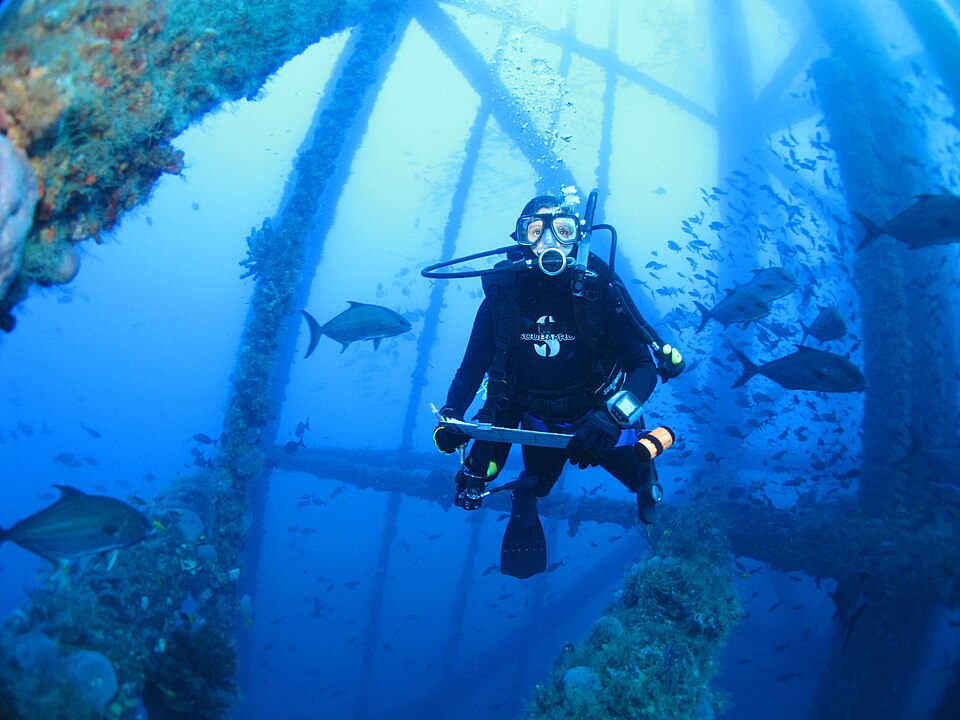
In its 2026 Volunteers of the Year announcement, NOAA recognizes Aaron Bouwkamp at Flower Garden Banks National Marine Sanctuary. The account describes support for research cruises, closed-circuit rebreather technical dives and mooring-buoy operations, particularly during the 2025 season. It also describes collaboration between sanctuary and Moody Gardens dive teams.
Those are specialized contributions reported by NOAA, not a menu of activities open to anyone with a recreational certification. The award does not establish a current vacancy or waive a program’s requirements. A reader interested in similar work needs the actual role description and the organization’s assessment of their suitability.
Useful skills also reach beyond the water
The same announcement recognizes Michael Sheridan’s education, ROV-program and data-management contributions at Gray’s Reef, and Serena DeSteno’s work with historical records supporting Stellwagen Bank’s Shipwreck Mapping Initiative. These examples show why a diver’s interest in conservation can lead to several kinds of work without making each role a diving assignment.
The NOAA volunteer portal provides links to individual sanctuaries and describes activities including diving, field observations, water-quality monitoring and visitor education. It is a starting directory. The local program determines which opportunities exist and what preparation they require.
Prepare a skills inventory, rather than a vague offer
Before approaching a program, write down what you can reliably contribute. Include relevant qualifications, recent experience, availability and practical skills. Database work, equipment organization, educational demonstrations or careful record transcription may be more useful than a general promise to help underwater.
Then identify the setting you can support. Offshore cruise work and a regular visitor-center shift place different demands on time and preparation. Ask the program about supervision, training, scheduling and the tasks actually available. An award profile describes one person’s established contribution; it is not a substitute for that conversation.
Keep your proposed contribution measurable. For example, being able to attend a recurring session or complete a defined records task gives a coordinator something concrete to assess. Avoid promising a technical role merely because it sounds close to the diving you enjoy.
Our article on structured reef observations explains another way to connect an underwater interest with a defined task. The common requirement is a method and a responsible program, rather than an impressive title.
Dates and scope: NOAA’s awards announcement was published October 23, 2026 and includes work from earlier seasons. The undated volunteer directory was checked October 25. No current placement, eligibility, qualification equivalence or TRIMIX affiliation is promised.
Join the discussion
Share a question or a useful experience about this article. Every comment is reviewed before it appears.