
A robot can gain useful control from its physical shape before adding a more complicated computer. An October 7, 2026 study of a feather-star-inspired swimmer demonstrates this idea underwater. It gives water-sports readers a concrete example of mechanical intelligence, a term that should not automatically be read as artificial intelligence.
Two inputs, several movements
North Carolina State University’s announcement describes a soft swimmer with four elastic wings and two actuators. Different actuation patterns produce vertical pulsation, directional swimming and rotation. The flexible parts return toward their resting shape after bending, helping the same structure make several movements.
The university calls these jellyfish, fish and rotor modes. Its October 7 announcement is the recent-month research source for this article; later internet coverage is not evidence that a different version has just launched.
Watch the control system, not only the motion
The original Science Advances paper explains that the demonstrated swimmer uses tethered pneumatic actuation. It also identifies a lack of onboard sensing and closed-loop feedback as current limitations. Its movement therefore does not demonstrate a self-contained robot independently finding a route through a natural reef.
The authors report difficulty controlling direction precisely while transitioning between modes, including residual rotation when moving from rotor to fish mode. That is an informative engineering result: making a body turn is different from making it settle accurately onto a chosen heading. Future autonomy and integration remain development work.
A useful way to read swimming-robot videos
Start by counting connections leaving the frame. A small moving body may depend on substantial equipment outside the camera view. Then ask which decisions happen onboard, which are made by an operator and which are prearranged. This does not diminish a successful mechanism; it identifies the mechanism’s actual contribution.
Next, look at a transition rather than a steady movement. Can the device go from hovering to turning to travelling in the intended direction? A stable repeating stroke and a controllable change between strokes answer different questions. For readers interested in underwater propulsion, that distinction is often more revealing than a single maximum-speed figure.
Our interpretation is that this study’s interest lies in obtaining several motions from a small number of inputs. It demonstrates a design strategy rather than a ready-made replacement for a diver propulsion vehicle or a board motor. Those products would also need their own power, control and application-specific operating evidence.
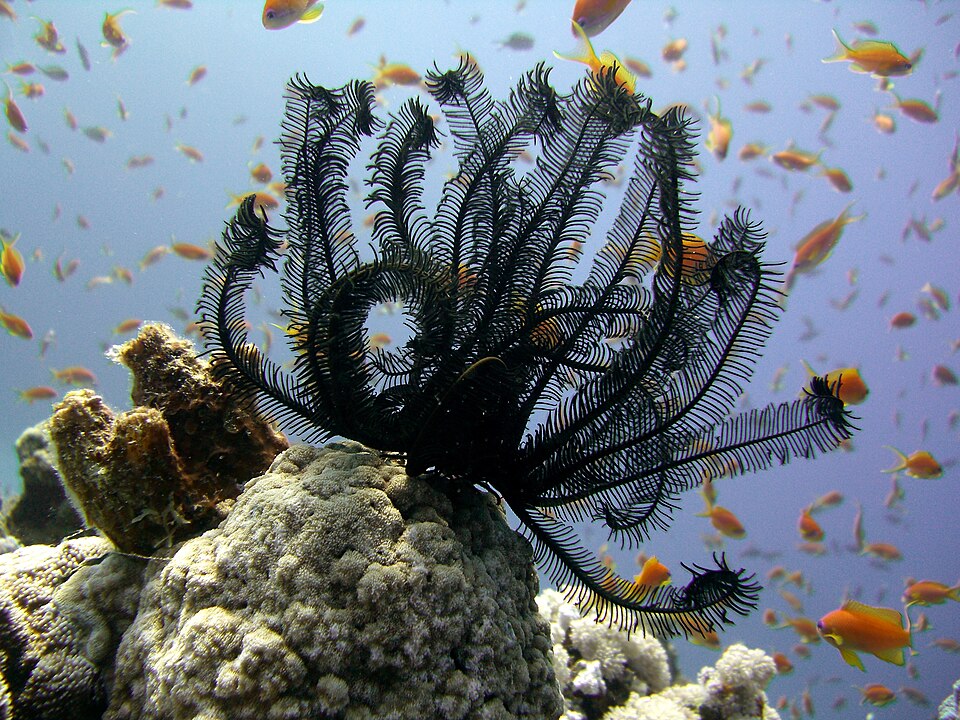
The photograph accompanying this article shows a real feather star, the biological context. It does not show the prototype or a field deployment. For further distinctions between a working mechanism and a complete usable system, see our underwater technology evidence checklist.
Checked October 26, 2026. University release and paper’s online article date: October 7. The journal issue is dated October 9. This is a recent-month research explainer.
Join the discussion
Share a question or a useful experience about this article. Every comment is reviewed before it appears.