
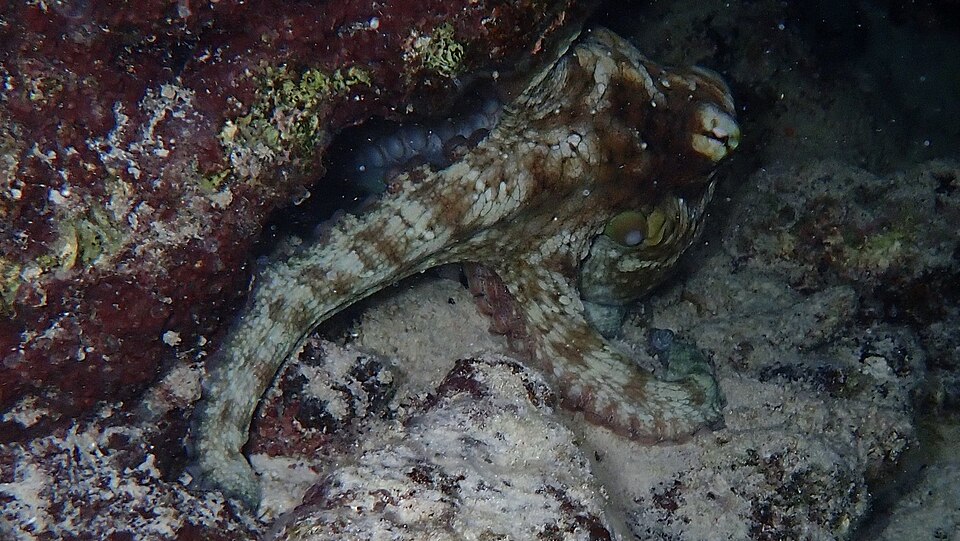
An octopus can blend into a rocky background, change shape and disappear behind another animal. That makes it a challenging subject for underwater video analysis. HideAndSeg, described in a Marine Biology paper published October 12, 2026, addresses one specific task: separating the animal’s visible outline from the rest of a video.
What the paper actually evaluates
The original study combines a trained object detector with a video-segmentation model. It uses field recordings of juvenile Octopus insularis from northeastern Brazil. The authors evaluate single-subject tracking, including a case where the animal becomes visible again after complete occlusion. This is a segmentation research workflow, rather than a consumer camera feature.
The paper also identifies limits. Multiple interacting octopuses would require further work, and agreement between different human annotators was not assessed. An outline that looks stable does not independently establish an animal’s identity, emotional state or the meaning of its behavior.
There is an implementation to inspect
The authors’ public repository describes a Python library integrating SAM2 and YOLOv11. Initial segmentation masks are used to train the detector, which then supplies prompts for subsequent segmentation. The documented workflow therefore includes preparation and training; automatic inference does not mean the entire research process happens without human input.
The repository lists software dependencies and the workstation used during development. That gives technically interested readers something more concrete than a promotional video, but it is not evidence that the same process runs inside a waterproof action camera. A notebook example and a working consumer application are different deliverables.
How this changes the value of an ordinary clip
Imagine a short recording where an octopus passes behind a rock. A useful output would retain uncertainty while it is hidden and recover the subject when it reappears. Simply carrying a colored patch across the hidden interval could make the video look continuous without providing a new observation. This is an editorial illustration of the evaluation problem.
For anyone contributing footage to a research project, ask the researchers what input they need and what analysis they intend to perform. Keep the original recording, rather than supplying only a version with labels burned into it. The raw clip and the model’s interpretation should remain distinguishable when somebody reviews a surprising result.
The journal publication is the current development discussed here. An earlier author preprint was first submitted in November 2025, so this is not a claim that the project first appeared this month. Our technology evidence checklist offers related questions about datasets, demonstrated functions and readiness.
Checked October 26, 2026. Journal paper: October 12; initial preprint: November 6, 2025. The contextual photograph is separate from the study’s recordings.
Join the discussion
Share a question or a useful experience about this article. Every comment is reviewed before it appears.