
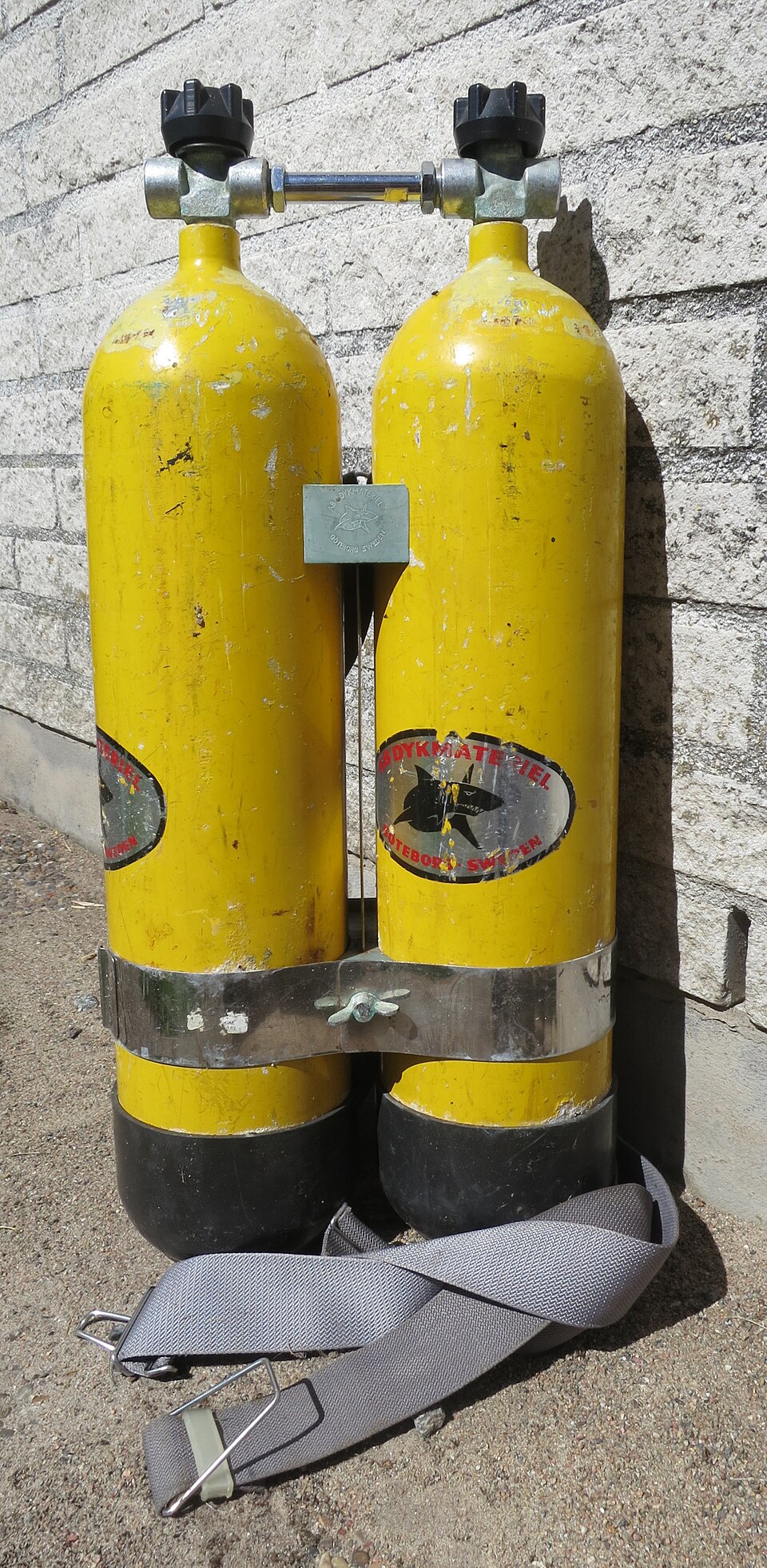
A twin-cylinder listing answers how many vessels are in an assembly. It leaves an equally important buying question open: how are the vessels, breathing assembly and controls documented for the model being offered? Ask for that documentation before treating two similar-looking rigs as equivalent.
Read what the T-4000 listing establishes
The TRIMIX T-4000 product page describes two 2 L cylinders under a shared manifold. It identifies a hose-connected breathing assembly, an extended pressure gauge and a carrying vest. In the Standard package, it lists a breathing regulator. The separate full-face-mask package has a different equipment list. Record the intended package with the request for its instructions.
The listing identifies a shared manifold, but it does not specify independent gas supplies, isolation behaviour or redundancy. Treat those as separate technical questions for the manufacturer and a qualified professional. Do not infer them from the count of cylinders, visible hoses, total capacity or the fact that the assembly has a gauge.
Use diagrams for the model they describe
In its archived Cordell Bank survey explanation, NOAA describes a particular technical diving setup with independent regulators and a valve between the cylinders. The useful point for a buyer is how specifically the source names the hardware. It describes NOAA’s example, with its own training and use context. It supplies no finding about the T-4000 or another twin-cylinder product.
Ask for a configuration file
- Record the product model, package, colour and assembly revision on the quotation.
- Ask for the applicable assembly diagram and manufacturer description of each control and gauge.
- Request the operating limits and service documents that correspond to the supplied breathing configuration.
- Ask a qualified provider whether they can assess the complete assembly and service its documented parts.
Keep the package packing list and the operating manual together. A substitute breathing component or an unlabeled change to the assembly can make the earlier documents incomplete. Request a written identification of the current parts before accepting the offer. This purchasing guide supplies no valve operation, dive plan or approval for a particular use.
Request the exact T-4000 package and manifold documentation and identify the configuration you are considering. Resolve any operating or service questions with the current model instructions and an appropriately qualified provider.
Evergreen equipment buying guide checked November 7, 2026. The TRIMIX page is undated. The NOAA page is in its 2010 survey archive and records a September 12, 2023 revision. Its first posting date is unstated. This guide documents the buying decision. It does not establish a product test or approve a specific setup.
Join the discussion
Share a question or a useful experience about this article. Every comment is reviewed before it appears.