
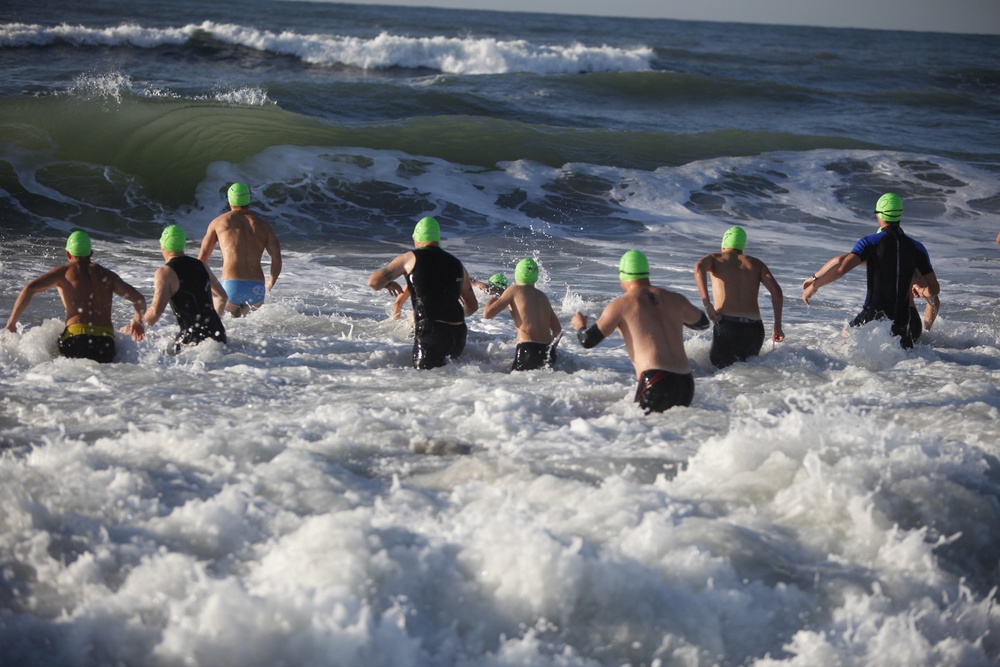
Two swimmers won the opening 10 km races of the 2026/27 Open Water Swimming World Cup on November 6 in Cancún, Mexico. Florian Wellbrock and Moesha Johnson both reached the finish first, but the intermediate sprint lap tells two different stories. In one race, a different athlete won that lap. In the other, the eventual winner took it and then spent time back in the pack.
The men’s sprint lap and final podium
The World Aquatics men’s race report places Wellbrock second at the first lap behind sprint-lap winner Marc-Antoine Olivier. It describes a tightly grouped field in choppy water. The finish had Wellbrock first, with Domenico Acarenza second and David Betlehem third. Record Olivier’s result as the sprint-lap result. The intermediate distinction belongs alongside the final classification, where it helps explain why seeing one swimmer lead an early crossing does not settle the medal order.
Johnson won both distinctions, with positions in between
According to the World Aquatics women’s race report, Johnson won the sprint lap and the associated bonus. The report then places her back in 17th position during the second and third laps. She returned to the front and took gold, ahead of Airi Ebina and Ginevra Taddeucci. In the same race, Ebina’s silver was her first World Cup podium, according to the federation. Those results show why writing down the early and final outcomes still leaves a useful gap: the race developed in between.
Build a race note around three observations
Keep three entries when reviewing a distance race: who took the intermediate distinction, where the eventual winner was later in the race when the reporting establishes it, and who finished on the podium. Write down the event and distance beside those entries. The two Cancún reports provide different amounts of detail about positions between the start and finish, so use the positions they actually document. A missing split is a reason to leave a blank rather than draw a smooth narrative between two known positions.
The earlier TRIMIX preview asked whether a pack or a solo effort would shape the opening races. These November 6 reports provide the first observed outcomes for the 10 km events. The reported conditions and individual choices help explain those races without establishing a universal pacing strategy.
Evidence dates. The 10 km races and both federation reports date to November 6, 2026. Sources checked November 7, 2026. By TRIMIX Sports.
Join the discussion
Share a question or a useful experience about this article. Every comment is reviewed before it appears.