
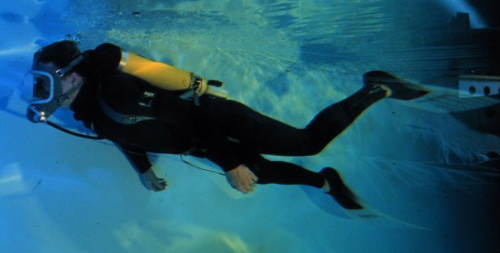
A compact cylinder can look less demanding than a large scuba set. Its appearance does not remove the change involved in breathing compressed gas underwater. The purchasing decision should include qualified instruction and assessment of the complete setup, rather than assuming that small equipment belongs to a simpler activity.
Read the warning before the convenience claim
The T-500 manual strongly recommends professional scuba training and certification and warns that use by untrained people can cause serious injury or death. It also contains model, environmental and companion-related precautions. Selecting a product’s smallest version does not cancel those statements.
This matters when a compact system is described beside snorkeling equipment. Being a confident swimmer or an experienced surface snorkeler does not demonstrate training in compressed-gas equipment. A product manual supplies essential instructions, but reading it is not the same as supervised learning and an assessment of practical skills.
Ask an instructor about the full configuration
PADI’s certification FAQ describes training with a regulator, buoyancy-control device, scuba tank, monitoring equipment and other items. A small-cylinder package should therefore not be treated as evidence that the other equipment and skills are unnecessary. The FAQ does not endorse or approve a T-500 for a particular course.
- Give the instructor the exact product manual and proposed equipment list.
- Describe the activity and environment you are considering.
- Ask what training, prerequisites and equipment assessment apply.
- Confirm separately whether the activity operator accepts the configuration.
A course or instructor may require equipment different from the item you first considered. Resolve that question before purchasing a kit for training. Do not assume that owning a regulator or having tried another person’s cylinder establishes qualification.
Address a real concern without dismissing the whole category
DAN’s discussion of common diving injuries describes serious pressure-related injuries and research into gas-supply and buoyancy problems. It supports taking compressed-gas training seriously; it does not provide a simple size-based boundary below which training becomes unnecessary.
The conclusion is compatible with a fair discussion of mini tanks. A compact product can be assessed for a documented role without pretending it is harmless or treating objections about training as hostility to innovation. A complementary system still has to fit the diver’s skills, the full equipment arrangement and the activity’s requirements. This article gives no breathing, ascent, rescue or medical procedure.
Ask about an identified configuration
Review the TRIMIX T-500 listing, then ask for the T-500 information relevant to your decision. Request the current manual for discussion with a qualified instructor. Explain the intended activity; an inquiry cannot replace a training or fitness assessment. The inquiry prepares an email; it is not an order, a sent message or confirmation of availability. No TRIMIX hands-on performance test is claimed here.
Evergreen buyer guide verified November 3, 2026. Source dates: T-500 user manual, English sections 1–7: undated; PADI: Scuba Diving Certification FAQ: undated; DAN: Common Diving Injuries and How To Avoid Them: undated. A current download is not evidence of a new launch. Follow the supplied model-specific instructions, qualified training and applicable local requirements; this article is not a dive plan, emergency procedure or filling instruction.
Join the discussion
Share a question or a useful experience about this article. Every comment is reviewed before it appears.