
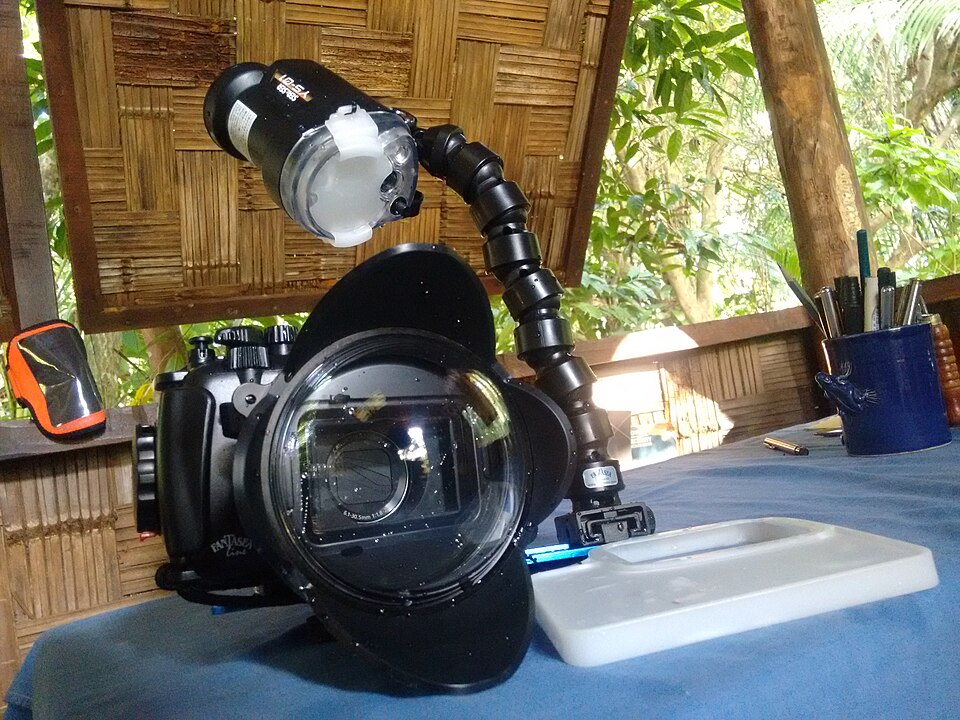
A strobe’s full-power flash count describes a different buying consideration from the delay before the next flash. A larger count does not, by itself, mean a faster sequence of photographs. Keep recycle time and flash capacity in separate columns, with the specified battery and test conditions beside both.
One model provides a useful counterexample
The INON S-220 specifications list approximately 2.1 seconds minimum full-power recycle time and about 380 full-power flashes with the specified eneloop batteries. For its listed 1.5-volt lithium test batteries, the figures are approximately 3.5 seconds minimum and about 640 flashes. Within that manufacturer’s data, the larger flash count accompanies a longer minimum recycling interval.
These are attributed specifications, not a TRIMIX test or a recommendation to substitute batteries. They show why a single endurance headline cannot answer both how many flashes a set may provide and how quickly a flash may be ready again.
Keep the conditions attached
The table identifies full-power measurements and the actual test-battery models. Retain those conditions when asking for a quotation or comparing a second strobe. A figure obtained at a different output level is a different comparison, and an approximate minimum is not a guaranteed interval for every photograph.
The S-220 manual separately specifies compatible batteries and limitations on repeated flashes. Recycling capability and permitted sustained use are therefore separate documentation questions. This article does not supply a firing sequence, cooling schedule, battery-loading or charging procedure.
Compare a shooting requirement with a complete system
- Write down whether the requirement concerns occasional single frames or a sequence of still images.
- Keep the maker’s recycle figure, power condition and battery identity together.
- Keep full-power flash capacity in its own field with its stated test conditions.
- Ask whether the camera, trigger and strobe documentation support the intended photographic task.
- Obtain the exact manual’s operating limitations before treating a specification as a shooting promise.
The camera’s recording rate is another specification. A camera advertising a rapid burst does not establish that an attached strobe will illuminate every frame. Conversely, a strobe becoming ready does not prove that the camera or triggering system is ready. Ask the supplier to identify the complete supported combination, and distinguish a documented feature from a demonstrated result.
Read the TRIMIX buying guide, then ask about actual lighting availability with the camera, housing, trigger and strobe models. No TRIMIX S-220 inventory, battery comparison or measured shooting rate is established.
Evergreen specification-reading guide checked November 6, 2026. The specification table is marked as of July 2023; an exact publication day is not stated. The current linked manual is an older document, not evidence of a new launch. TRIMIX has not tested output, endurance or thermal behaviour. Preparing an inquiry does not send it or order equipment.
Join the discussion
Share a question or a useful experience about this article. Every comment is reviewed before it appears.