
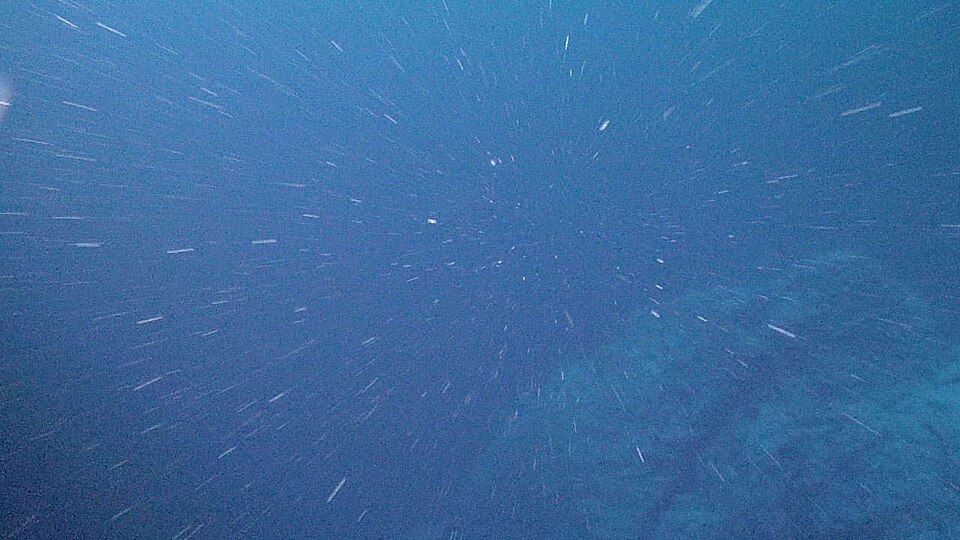
Particles drifting through an underwater photograph can seem like something to edit out. A University of Rhode Island research announcement published October 5, 2026 considers a different question: could artificial intelligence learn what some of those particles contain? The idea is scientifically interesting precisely because appearance alone is not a chemical measurement.
A project to test a possibility
The URI announcement describes a collaboration involving Melissa Omand and University of Maine researchers to connect images of marine snow with information from physical samples. The three-year project is scheduled for January 2027 through December 2029. Its aim is to test whether visible particle characteristics can help predict composition, including questions about microplastics and the movement of carbon and nutrients.
That wording matters. The university describes a research effort that will develop and test models, not a finished underwater camera that identifies every particle. The October story should not be shared as proof that the problem has already been solved or that an equivalent capability is available in recreational equipment.
What marine snow means
NOAA’s marine snow explainer describes material sinking from upper waters, including biological debris, and its role in supplying food to deep-ocean organisms. The term is an ecological description. It does not mean that every bright dot in a photograph has the same contents or origin.
For photographers, this creates two different goals. An attractive holiday photograph may emphasize a subject and reduce visual distractions. A scientific image may need to retain information about those distractions, together with measurements and collection details. A cleaner-looking picture is not automatically a more informative record.
Questions that make AI claims easier to assess
When a future article says an algorithm identifies underwater material, ask what reference measurements were used. A model that has been compared with laboratory information supports a different claim from software that groups visually similar objects. The label attached to an image deserves as much attention as the image itself.
Next, ask which environments are represented in the evidence. Performance on one collection of pictures should not be assumed to transfer unchanged to another camera, location, or set of water conditions. If the report does not address those differences, leave the broader application open.
Finally, separate image enhancement from scientific inference. Changing contrast or color can make something easier to see without establishing its composition. Neither an appealing demonstration nor an AI label is a reason to add an unsupported detection capability to a product description.
This is a past-month research briefing, checked October 23, 2026, rather than a new result released today. TRIMIX has not tested the proposed system. For specifications of actual equipment, consult the exact documentation and use TRIMIX Support for product questions.
Join the discussion
Share a question or a useful experience about this article. Every comment is reviewed before it appears.