
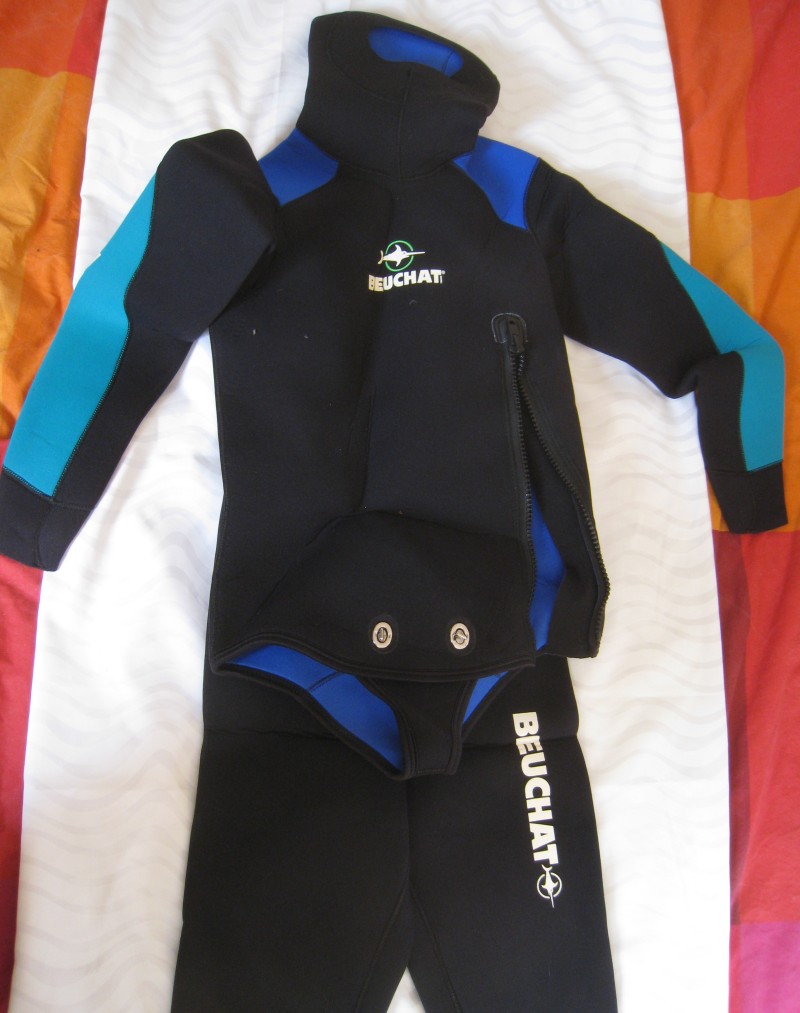
A multiple-thickness wetsuit label gives you numbers, but it may not give you the complete panel map. If you are comparing suits for snorkeling, ask where each stated thickness actually sits on the named garment. Two labels reading 3/2 can describe different coverage through the legs.
Two manufacturers explain the numbers differently
O’Neill’s US wetsuit FAQ, which does not state a publication date, explains its 3/2 example as 3 mm through the core and 2 mm through the arms and legs. Patagonia’s November 26, 2025 guide describes its Regulator 3/2 full suit as 2 mm in the shoulders and arms, with 3 mm across the rest of the suit, including the legs. Both documents were checked October 31, 2026.
That difference is enough to reject a universal reading of the label. It does not establish which suit is warmer for a particular person, and it is not a side-by-side performance test. Patagonia’s example also uses natural-rubber construction; a comparison should retain the actual material description rather than relabelling all wetsuits as the same foam.
Turn the label into a purchasing record
- Identify the exact garment: retain its model, generation, full-suit or short-suit cut and any hooded variant.
- List the zones: request the thickness at the torso, shoulders, arms and legs; add the hood where relevant.
- Separate materials: record the maker’s foam or rubber description and lining information in their own fields.
- Keep evidence with the row: save the relevant diagram or written confirmation, including its revision or date.
If a retailer only repeats “3/2” and a warmth adjective, leave the leg-thickness entry unresolved. Do not silently fill it from another brand’s FAQ. Similarly, a third number on a hooded product needs the maker’s explanation: its position in the name is not sufficient evidence of which body area it describes.
Use the map to ask a better local question
Give the operator or qualified equipment adviser the actual panel map and planned activity, rather than asking them to interpret the bare number. A manufacturer’s surfing temperature table is a stated recommendation for its own products and context; it does not automatically become a snorkeling temperature prescription.
This comparison is useful even when you already know your clothing size. Size identifies the offered garment dimensions, while the zone map identifies its construction. Keep both available when requesting a specific model or considering an alternative.
Ask a useful equipment question
Read the TRIMIX buying guide for the inquiry process. To ask about actual supply or documentation, use product-context support and include the exact model, intended activity and the specification you need confirmed. An inquiry prepares an email; it is not an order or confirmation of availability.
Evergreen equipment guide. Checked October 31, 2026. Source publication dates are identified above; an undated page is not a new-product announcement. Specifications and performance statements belong to their manufacturers. This article reports documentation, not a TRIMIX hands-on test.
Join the discussion
Share a question or a useful experience about this article. Every comment is reviewed before it appears.